


If you have ever spoken to an architecture student during jury week, you have probably heard some version of the same sentence: “Architecture is one of the hardest degrees you can study.” With design revisions, drawings, physical models, presentations, software work and constant deadlines, it is easy to understand why an architecture degree has earned that reputation.
But is architecture actually one of the top 3 hardest degrees in the world? The most accurate answer is that there is no official global ranking that can scientifically place architecture at number one, two or three. Degree difficulty depends on the university, curriculum, assessment system and even what we mean when we call a course “hard.”
Medicine can be difficult because of the enormous amount of information and clinical responsibility involved. Engineering may be highly demanding because of mathematics, physics and technical problem-solving. Architecture combines a different collection of challenges: creativity, technical knowledge, continuous project work, design criticism and an unusually heavy workload.
So while calling architecture definitely one of the top three hardest degrees would be too absolute, there is a strong argument for considering it one of the most demanding professional degrees a student can pursue.
Why Is Architecture Considered One of the Hardest Degrees?
Architecture is unusual because it refuses to fit neatly into one academic box. An architecture student is expected to think like a designer, understand structures, study human behaviour, learn about materials and construction, communicate visually and develop enough technical knowledge to transform an idea into a believable building.
That makes studying architecture very different from courses where academic success is largely determined by written examinations. In architecture school, understanding theory is only the beginning. Students must use that knowledge to create an original solution and then explain and defend the decisions behind it.
The difficulty therefore comes not simply from how much architecture students learn, but from how many different abilities they are expected to use simultaneously.
Is Architecture Really a Top 3 Hardest Degree?
Search for the hardest degrees to study and architecture frequently appears alongside medicine, chemical engineering, aerospace engineering, physics and law. Some popular rankings even place architecture at number one, usually because of the amount of time architecture students spend working outside scheduled classes.
A widely cited analysis of the 2016 National Survey of Student Engagement reported that architecture students spent an average of 22.2 hours per week preparing for class outside classroom hours, including studying, homework and studio-related work. Architecture recorded the highest preparation time in that particular comparison.
That is useful evidence showing why architecture has such a reputation for workload. However, it does not establish an official worldwide ranking of degree difficulty. Workload is only one way of measuring how difficult a university course is.
Exam pressure, mathematical complexity, amount of information to memorise, practical training and professional responsibility could all produce very different lists.
The better answer, therefore, is that architecture cannot objectively be declared one of the top three hardest degrees, but it certainly belongs in the wider discussion about the most difficult and time-consuming university courses.
Also read – Top 10 Architects in Mumbai: Inspiring Visionaries Redefining Indian Architecture
Architecture Is Hard Because There Is No Single Correct Answer
One of the biggest surprises for new architecture students is discovering that working hard does not automatically lead to one clearly correct answer.
In mathematics, an equation may have a defined solution. In architectural design, several approaches could solve the same problem, but some may respond better to the site, users, climate, circulation or surrounding context.
A student could spend days developing a floor plan only to discover during a design review that the circulation is weak, the scale feels uncomfortable or the central concept has not translated into the actual building.
That often means going back and changing hours of work.
This continuous cycle of design, feedback, revision and redesign is one of the main reasons architecture school feels so intense. Students are not simply completing assignments. They are learning how to make decisions when the answer is not already waiting in a textbook.
Architecture Studio Creates a Very Different Kind of Workload
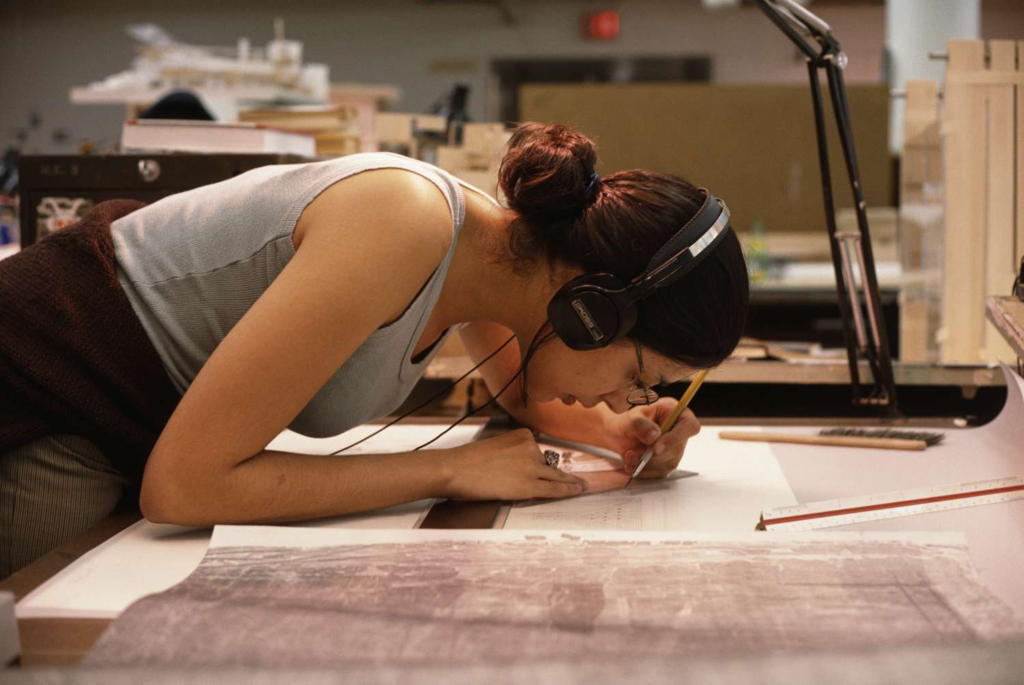
The architecture design studio sits at the centre of most architectural education. Instead of preparing only for a final examination, architecture students usually develop projects over several weeks or months.
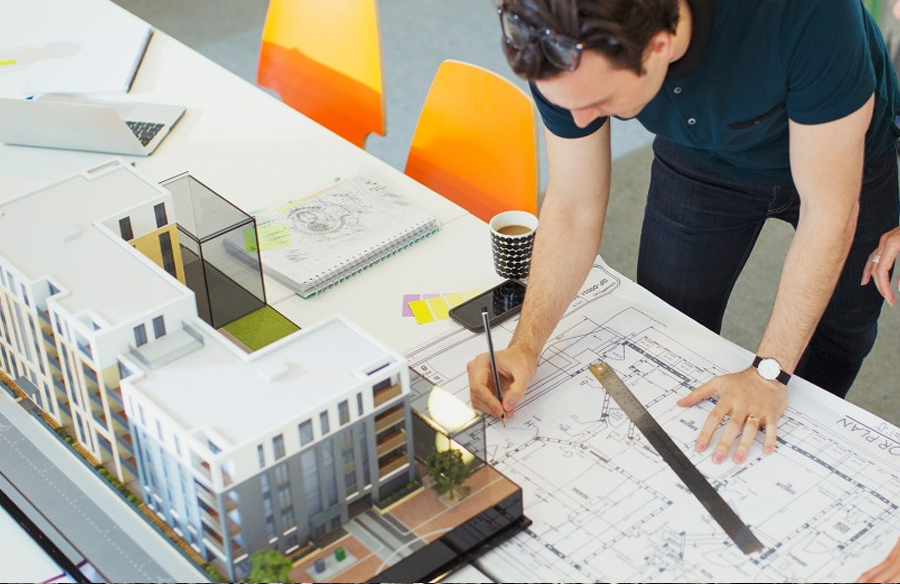
A project may begin with site analysis and research before moving through concept development, sketches, plans, sections, elevations, models, visualisations and a final presentation.
The difficult part is that architecture projects can almost always be improved.
A plan can be refined. A model can be rebuilt. A render can look better. A section can communicate more information. A presentation sheet can be redesigned.
Because there is rarely an obvious moment when a design becomes completely “finished,” students can spend far more time on an architecture project than they initially expected.
This is where the famous architecture-school deadline pressure comes from. Healthy design education should never treat exhaustion or all-nighters as proof of commitment, but the inherently time-intensive nature of studio work remains one reason architecture is considered a hard degree.
Architecture Requires Creativity and Technical Knowledge Together
Many people enter architecture believing it is primarily about drawing attractive buildings. They quickly discover that an architecture course exists somewhere between art, science, technology and construction.
Students can encounter architectural design, building construction, structures, materials, building services, history, theory, climatology, urban design, professional practice and digital representation during their education.
A beautiful concept is not enough if people cannot comfortably use the building. A dramatic form still needs structure. Spaces need light, ventilation, circulation and appropriate dimensions. Materials need to behave appropriately in the climate and context.
This combination makes architecture particularly challenging. Students who are naturally creative may initially struggle with technical subjects, while students who enjoy mathematics and clearly defined problems sometimes need time to become comfortable with subjective design thinking.
Architecture demands both imagination and practicality.
Why the Five-Year B.Arch in India Can Feel Especially Intense
For students wondering “Is architecture hard in India?”, the duration of the degree itself is important.
The Council of Architecture describes the undergraduate Bachelor of Architecture programme in India as a five-year degree course. The educational framework also includes practical training as part of the architecture programme.
That means students are committing to a longer undergraduate journey than many conventional bachelor’s programmes.
Those five years are not simply years of attending classroom lectures. Architecture education progressively moves through design studios, technical courses, increasingly complex projects, professional exposure and eventually major final-year work such as the architectural thesis.
The length reflects the nature of architectural learning. Spatial thinking, design judgement and technical understanding develop through practice rather than memorisation alone.
Architecture Juries Make You Defend Your Ideas
Then there is one experience architecture students rarely forget: the architecture jury.
Instead of quietly submitting an assignment and waiting for marks, students may be expected to pin up drawings, display models and present their entire design process to faculty members or external reviewers.
A reviewer could ask why the entrance has been positioned in a particular place. Another may question the circulation. Someone may ask whether the structure actually works or whether the building responds properly to climate.
Students therefore have to understand their designs well enough to defend them.
These architecture juries can initially feel intimidating, but they teach an important professional skill. Architecture is not only about having an idea. Architects must be able to communicate why that idea makes sense.
Students gradually learn how to receive criticism, analyse useful feedback and improve a project without treating every design comment as a personal attack.
Is Architecture Harder Than Engineering?
The question “Is architecture harder than engineering?” does not have one universal answer because the two fields are difficult in different ways.
Engineering degrees can involve deeper mathematical analysis, advanced physics and technically precise problem-solving, depending on the engineering discipline. Architecture generally introduces a broader mixture of creative design, technical understanding and project-based work.
An architecture student might research a site, solve circulation, develop drawings, produce a model and prepare a visual presentation for the same deadline.
Someone who enjoys equations and clearly defined technical problems may find engineering more natural. Someone who enjoys visual thinking and open-ended design problems may prefer architecture.
So architecture is not automatically harder than engineering. It simply challenges students differently.
Is Architecture Harder Than Medicine?
Comparing architecture vs medicine difficulty creates a similar problem.
Medical education involves extensive scientific learning, clinical training and eventually situations in which professional decisions can directly affect people’s health. Architecture does not involve that same form of clinical responsibility.
Architecture’s challenge instead comes from long project cycles, constant iteration, technical coordination, subjective criticism and the need to repeatedly produce original work.
Both can be extremely rigorous professional pathways. Trying to crown one as the absolute hardest degree overlooks how different the demands actually are.

Do You Need to Be Good at Maths to Study Architecture?
Another common reason students worry about the difficulty of architecture is mathematics.
Architecture does require students to be comfortable with measurements, geometry, scale and logical thinking. Numerical understanding also becomes relevant when dealing with structures, quantities, building performance and dimensions.
However, architecture is not simply an advanced mathematics degree.
Spatial awareness, observation, design thinking, curiosity and problem-solving are equally important. Architecture students have to understand relationships between people, spaces, buildings and cities rather than simply solving calculations.
Being weak at mathematics does not automatically mean you cannot study architecture. But being unwilling to engage with technical thinking will make the architecture course much more difficult.
What Actually Makes a Good Architecture Student?
The best architecture student is not necessarily the person who arrives at university already drawing like a professional illustrator.
Drawing can improve. Software can be learned. Model-making gets better with practice. Presentation skills develop over time.
What matters far more is curiosity.
Strong architecture students begin noticing why one street feels inviting while another does not. They watch how sunlight moves through a room, where people naturally gather in public spaces and how materials change as buildings age.
They are also willing to revise their ideas.
Architecture school constantly encourages students to question the first solution rather than becoming attached to it. Being able to say “this isn’t working yet” and rethink a project is one of the most valuable skills an architecture student can develop.
Can Architecture Be Hard and Still Be Enjoyable?
Absolutely. A degree being difficult does not automatically make it a bad choice.
For someone who genuinely loves architecture and design, the variety of the course can make the workload worthwhile. One semester could involve designing a residence while another might explore a school, cultural centre, public building or urban intervention.
Every architecture project introduces a different site, different users and different design questions.
There is also a unique satisfaction in watching a rough sketch slowly become a complete architectural proposal through plans, sections, models and visualisations.
The workload can be heavy, but for the right student, the creative process can also make studying architecture extremely rewarding.
Should You Study Architecture If You Are Worried It Is Too Hard?
Do not reject architecture simply because you heard it described as one of the top 3 hardest degrees.
Ask yourself a more useful question: are you interested enough in architecture to remain curious when the course becomes demanding?
If you enjoy buildings, cities, design, problem-solving and creative experimentation, the difficult parts of architecture have a purpose. You are learning how to take an unclear problem and gradually turn it into a thoughtful spatial solution.
Architecture can be particularly difficult for students who choose it only because they enjoy sketching or because being an architect sounds glamorous.
The degree also requires patience, research, technical understanding, revisions, criticism and long-term project work.

Is Architecture One of the Top 3 Hardest Degrees?
There is no credible universal academic ranking that officially identifies the three hardest degrees in the world, so saying architecture is definitely a top-three hardest degree would be misleading.
Different courses are difficult for entirely different reasons, and individual strengths can dramatically change the experience.
Still, architecture has a convincing claim to being one of the hardest and most demanding undergraduate degrees. Its studio workload, five-year B.Arch structure in India, technical subjects, design juries, practical learning and repeated cycle of criticism and revision require far more than artistic talent.
Perhaps that is exactly why architecture attracts people who enjoy difficult questions.
The degree teaches students to look at an empty site and imagine what could exist there, then test that idea against structure, climate, context, function and human experience.
So, is architecture hard? Definitely. Is architecture officially one of the top 3 hardest degrees? Not necessarily.
But for someone genuinely fascinated by buildings, spaces and the way people experience them, architecture can be one of the most challenging, creative and rewarding degrees to pursue.