

Choosing between architecture and engineering often leads to one big question: Is architecture harder than engineering? At first glance, both careers seem equally demanding. Architects spend years learning design, construction, materials and spatial planning, while engineers deal with mathematics, physics, structures, machines, technology and problem-solving.
The reality is that there is no universal answer to whether architecture is harder than engineering. Both professions are challenging, but they test completely different abilities. Architecture may feel harder for someone who struggles with creativity, design thinking and long project hours, while engineering may feel harder for someone who finds mathematics, physics and technical calculations difficult.
To understand the difference properly, it helps to look at how architecture and engineering differ in education, workload, creativity, technical complexity, career pressure and everyday professional life.
Is Architecture Harder Than Engineering? The Short Answer
Architecture is not automatically harder than engineering, and engineering is not automatically harder than architecture. The difficulty depends heavily on the student’s interests, strengths and learning style.
An architecture student might spend hours developing a concept, creating drawings, building models, preparing presentations and repeatedly redesigning a project. An engineering student, on the other hand, may spend those hours solving mathematical problems, understanding complex scientific principles, programming systems or analysing technical performance.
This is why the architecture vs engineering difficulty debate rarely has one clear winner. Architecture tends to combine creativity and technical knowledge, whereas engineering usually places greater emphasis on analytical reasoning, mathematics and scientific accuracy.

Why Architecture Can Feel Surprisingly Difficult
One of the biggest misconceptions about architecture is that it is mainly about drawing attractive buildings. Architecture education is far more complex.
Students must understand architectural design, construction technology, structures, environmental considerations, materials, building services, history, theory and professional practice. They are also expected to convert abstract ideas into spaces that could realistically be built.
The challenging part is that architectural problems rarely have one correct answer. Give ten architecture students the same site and design brief, and you could receive ten completely different solutions.
This uncertainty makes studying architecture difficult in a very different way from many conventional academic subjects. Students are constantly designing, reviewing, changing and defending their decisions.
Also read – 7 Powerful Lessons from Tokyo Earthquake Engineering That Make Tall Buildings More Resilient
Engineering Is Difficult for a Completely Different Reason
Engineering courses are widely considered academically demanding because they rely heavily on mathematics, science and logical problem-solving.
Depending on the engineering specialisation, students may study subjects such as calculus, mechanics, thermodynamics, electronics, programming, structural analysis, fluid mechanics or material science. These subjects often involve precise calculations where small mistakes can completely change the answer.
For students who enjoy mathematics and logical reasoning, engineering may actually feel more straightforward than architecture. There is often a clearer method for solving technical problems.
However, for students uncomfortable with advanced mathematics or physics, engineering can be much harder than architecture.
Architecture vs Engineering: Creativity or Calculations?
Perhaps the biggest difference between architecture and engineering is how creativity is used.
Architecture requires students to think creatively almost constantly. An architect does not simply calculate whether a building works. They must consider how people experience that building, how spaces connect, how natural light enters, how the structure responds to its surroundings and what the overall design communicates.
Engineering involves creativity too, but engineering creativity is generally more focused on finding efficient and technically reliable solutions to defined problems.
An architect may ask, “What kind of space should exist here?”
An engineer may ask, “How can we make this solution work safely and efficiently?”
Neither question is necessarily easier. They simply demand different ways of thinking.
The Architecture Workload Can Be Intense
One reason many students consider architecture harder than engineering is the amount of time architectural projects can consume.
Architecture assignments are rarely completed simply by studying a chapter and writing an examination. Students may need to conduct site studies, develop concepts, produce plans and sections, create digital models, prepare physical models, make presentation sheets and explain their design decisions during juries.
A design project can continue evolving until the final submission. Even after hours of work, a student might realise that the circulation does not work or that the entire concept needs reconsideration.
This makes architecture school workload particularly demanding because the work can feel continuous rather than limited to examinations.

But Engineering Has Serious Academic Pressure Too
Engineering education may not always involve the same type of studio culture, but the academic pressure can be significant.
Complex equations, laboratory work, practical assignments, programming exercises, technical examinations and project work require strong conceptual understanding. Students often cannot rely entirely on memorisation because many engineering questions require applying principles to unfamiliar problems.
Fields such as electrical engineering, mechanical engineering, chemical engineering, aerospace engineering and civil engineering can become highly technical.
So while architecture students may struggle with open-ended design projects, engineering students often face the pressure of technical accuracy and difficult calculations.
Which Has More Mathematics: Architecture or Engineering?
If mathematics is your biggest concern, engineering generally involves more advanced and intensive mathematics than architecture.
Architecture does require mathematical understanding. Architects work with dimensions, scale, geometry, structural principles, areas, quantities and proportions. However, architectural education generally does not revolve around advanced mathematics to the same extent as many engineering programmes.
Engineering students typically encounter calculus, differential equations, numerical methods, statistics and other specialised mathematics depending on their field.
Therefore, students searching for architecture vs engineering which is harder in maths will usually find engineering more mathematically demanding.
That does not necessarily make architecture easier overall. It simply means that its difficulty appears elsewhere.
Architecture Requires You to Accept Subjective Feedback
Another surprisingly difficult part of architecture education is criticism.
Engineering solutions can often be tested against measurable criteria. A calculation may be correct or incorrect, and a system may meet or fail a technical requirement.
Architectural design is much more subjective.
During design reviews and juries, students must present their ideas to professors or practising architects who may challenge the concept, planning, form, material choices or overall design approach.
There may not always be one obvious solution.
Learning to receive criticism, defend your decisions and redesign your project repeatedly is an important part of becoming an architect. For some students, this makes architecture psychologically more demanding than subjects where marks are determined mainly through examinations.
Is Architecture Harder Than Civil Engineering?
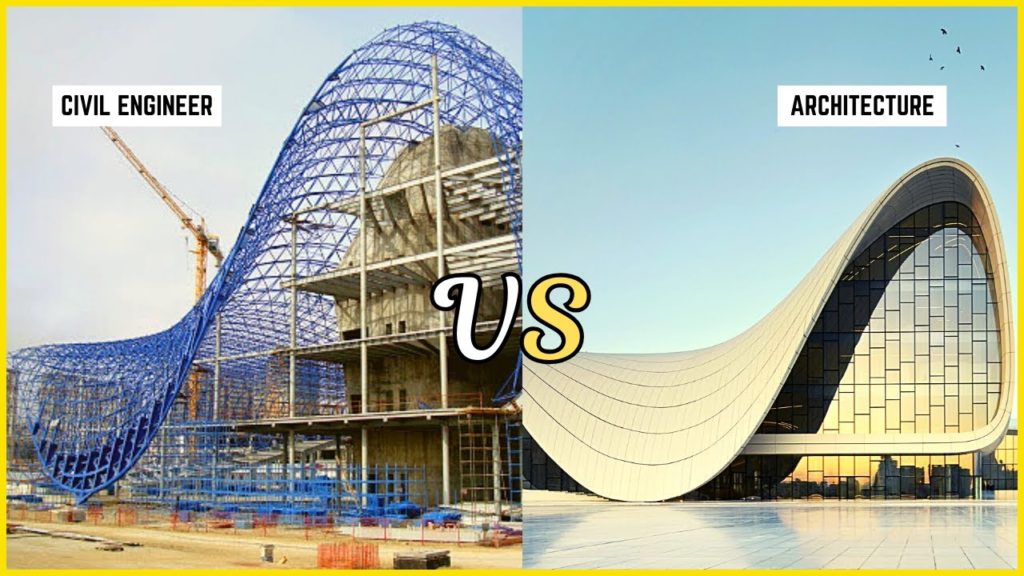
Architecture and civil engineering are closely connected, which makes this one of the most common comparisons.
Architects primarily focus on the design, planning, function and experience of buildings and spaces. Civil engineers focus more heavily on technical systems, infrastructure, structural performance, construction and engineering calculations.
A student strong in physics and mathematics may find civil engineering easier than architecture because engineering problems can feel more systematic.
Someone who enjoys visual thinking, design, sketching and spatial problem-solving may find architecture easier and more enjoyable.
The interesting part is that architects and civil engineers frequently work together. A visually ambitious architectural concept still needs engineering expertise to make it safe and technically achievable.
Is Architecture Harder Than Computer Engineering?
Comparing architecture with computer engineering reveals an even bigger contrast.
Computer engineering and related technology fields can involve programming, electronics, computer architecture, algorithms and mathematical reasoning. Students need strong logical thinking and often spend significant time debugging problems.
Architecture students spend similar amounts of effort solving problems, but those problems are spatial and visual rather than primarily computational.
Someone who loves programming but dislikes drawing, spatial thinking and design presentations may find architecture significantly harder. Someone comfortable with creative experimentation but frustrated by coding may experience the opposite.
This is why asking whether architecture or engineering is harder without considering personal aptitude can be misleading.
Which Course Requires More Creativity?
Architecture usually requires more continuous visual and spatial creativity.
From the beginning of architecture school, students are expected to generate ideas rather than simply reproduce information. They explore form, scale, materials, movement, landscapes, communities and human behaviour.
Even technically correct buildings may not necessarily be considered successful architectural designs if they lack thoughtful planning or a strong concept.
Engineering absolutely requires innovation, particularly when solving complex real-world problems, but traditional engineering education often places greater importance on technical correctness and analytical problem-solving.
For students who enjoy imagination and experimentation, this creative challenge can make architecture exciting rather than difficult.
Architecture Is More Than Being Good at Drawing
Another common misconception is that students must be excellent artists before studying architecture.
Drawing skills certainly help, but architecture is mainly about communicating ideas and understanding space. Modern architects work with sketches, technical drawings, diagrams, physical models and architectural software.
More importantly, aspiring architects need curiosity.
Why does one street feel comfortable while another does not? Why does sunlight make one room feel welcoming? Why do people naturally gather in particular spaces? Why do certain materials work better in particular climates?
These are architectural questions.
So students wondering whether architecture is difficult for an average student should focus less on artistic talent and more on whether they genuinely enjoy observing, designing and solving spatial problems.
Does Architecture Take Longer Than Engineering?
In India, a Bachelor of Architecture or B.Arch programme generally takes five years, while a conventional B.Tech or B.E. engineering programme usually takes four years.
That additional year can make architecture feel like a longer academic commitment. Architecture education also includes studio work, technical subjects, professional exposure and practical training components.
However, course duration alone does not determine difficulty.
Engineering students may complete their undergraduate programme earlier, but certain engineering disciplines can involve extremely demanding semesters filled with complex technical coursework.
The better question is not simply which course is longer, architecture or engineering, but which type of education fits your abilities better.
Who Works Longer Hours: Architects or Engineers?
Professional workload varies enormously in both industries.
Architects often experience particularly demanding periods around design competitions, client presentations, tender deadlines and construction milestones. Revisions can happen repeatedly because projects evolve according to client requirements, budgets, regulations and site conditions.
Engineers also deal with deadlines, site pressure, product launches, infrastructure projects and technical failures depending on their specialisation.
Architecture therefore does not automatically guarantee longer working hours than engineering. Much depends on the organisation, industry, project type and professional position.
However, architecture is often considered deadline-intensive because design work can keep expanding until the team decides that a solution is ready.
Which Career Is More Stressful: Architecture or Engineering?
Both careers carry significant responsibility.
Architects must coordinate client expectations, regulations, contractors, consultants, budgets, design quality and construction realities. What looks elegant on a drawing must eventually function in the real world.
Engineers face similar pressures because their decisions can influence structural safety, manufacturing, transportation systems, software infrastructure, machines, electrical networks and countless other systems people depend on.
The source of stress is different.
Architectural stress often comes from balancing creativity, client expectations, budgets and technical limitations, while engineering stress often comes from delivering reliable technical performance with minimal room for error.
Architecture vs Engineering Salary Should Not Decide Everything
Students comparing architecture and engineering often immediately ask which career earns more.
Income varies too widely across disciplines, cities, companies and experience levels for a simple comparison. Engineering also contains an enormous range of fields, from civil and mechanical engineering to software, electronics and aerospace engineering.
Architecture has its own career routes, including architectural practice, interior design, urban design, landscape architecture, computational design, project management, academics and independent practice.
Instead of choosing entirely based on starting salary, students should consider long-term interest and skill development.
A career that looks financially attractive but does not match your abilities can quickly become difficult to sustain.
Who Should Choose Architecture?
Architecture may suit you if buildings, spaces, cities and design genuinely fascinate you.
Students who enjoy creative problem-solving, visual communication, observing human behaviour and developing ideas over long periods often adapt well to architecture.
You also need patience. Architectural designs change repeatedly, and even experienced architects continue learning from clients, consultants, construction sites, materials and new technologies.
If you enjoy asking why spaces look, feel and function the way they do, architecture as a career may be worth exploring seriously.
Who Should Choose Engineering?
Engineering may suit students who enjoy mathematics, science, technology and structured problem-solving.
If understanding how systems work excites you, engineering offers an extraordinary range of possibilities. You could work with buildings, machines, computers, electronics, energy, transportation, aerospace systems or emerging technologies depending on your specialisation.
Engineering is particularly rewarding for people who enjoy breaking complicated problems into smaller technical questions and finding efficient solutions.
The best engineering students are not necessarily people who memorise equations quickly. They are usually people who are genuinely curious about how things work.
So, Is Being an Architect Harder Than Being an Engineer?
There is no objective winner in the architect vs engineer difficulty debate.
Architecture can be harder because of its intensive workload, subjective criticism, constant creative decision-making and combination of artistic and technical responsibilities. Engineering can be harder because of advanced mathematics, scientific complexity, technical precision and demanding analytical subjects.
Architecture tests how creatively you can solve problems while respecting real-world constraints.
Engineering tests how accurately and efficiently you can solve technical problems using scientific principles.
Both careers require intelligence, discipline and persistence, but they reward different strengths.
The Better Question: Which One Would Feel Harder to You?
Instead of asking, “Is architecture harder than engineering?”, ask yourself what type of challenge you would rather spend years solving.
Would you enjoy spending hours developing a building concept, changing layouts, studying materials and thinking about how people experience a space? Architecture might feel demanding, but meaningful.
Would you rather understand how structures, machines, computers, electronics or technological systems function and use mathematics to solve complex problems? Engineering may be the better fit.
A difficult course that genuinely interests you often feels easier than an “easy” course you have no interest in.
Architecture vs Engineering: Two Difficult Careers, Two Very Different Minds
Architecture and engineering should not really be viewed as professions competing against each other. Some of the world’s most ambitious buildings, infrastructure projects and cities exist because architects and engineers combine their expertise.
Architects imagine possibilities. Engineers help determine how those possibilities can safely and efficiently become reality. Increasingly, the boundaries between the two are also becoming more collaborative as digital design, computational tools, advanced materials and new construction technologies reshape both professions.
So, is architecture harder than engineering? Architecture may be harder creatively and in terms of continuous project workload, while engineering is often harder mathematically and technically.
The better career depends on the kind of problems you naturally enjoy solving.
If you are fascinated by buildings, cities, materials, people and the way spaces shape everyday life, architecture could be the challenge you are looking for. If numbers, machines, technology, systems and scientific problem-solving excite you more, engineering may feel far more natural.
Neither profession is an easy shortcut.
But choosing the one that matches the way your mind works can turn difficulty into curiosity, and eventually, curiosity into a career.