


If you are planning a career in interior design, one question usually arrives soon after the excitement about layouts, materials and beautiful spaces: how much does an interior designer actually earn?
The Interior Designer Salary in India can vary dramatically depending on experience, city, employer, project type, technical ability and the amount of responsibility a designer handles. This is why searching for one single salary figure rarely tells the complete story.
As of September 2026, Indeed reports an average Interior Designer Salary in India of ₹23,572 per month, based on 481 reported salaries. The same source shows a reported overall salary range of approximately ₹10,602 to ₹52,409 per month. These numbers provide a useful benchmark, but they should not be read as fixed salaries for every designer working in India.
So what can a fresher expect? How much does the Interior Designer Salary change after three, five or ten years? And what separates a ₹20,000-a-month role from one that pays considerably more?
Here is a closer look at the Interior Designer Salary in India for 2026–27.
Interior Designer Salary in India 2026–27: What Does the Current Data Say?
The current national average gives us a useful place to begin.
Indeed’s September 2026 data puts the average Interior Designer Salary at ₹23,572 per month. Annualised simply over twelve months, that is around ₹2.83 lakh a year, although actual annual compensation structures can include bonuses, incentives or other benefits.
Glassdoor provides another useful perspective on the progression of the profession. Its current salary trajectory estimates place junior interior designers around ₹3–4 lakh in total annual pay, interior designers around ₹3–6 lakh and senior interior designers around ₹5–8 lakh.
Those figures immediately reveal something important about the Interior Designer Salary: there is no neat salary ladder that applies to every professional.
A designer working in a small residential studio may earn differently from someone in a large organised interiors company. A designer managing luxury homes may have a completely different earning curve from someone producing drawings for commercial fit-outs.
Salary therefore follows responsibility almost as much as it follows experience.
Interior Designer Salary for Freshers: What Can You Expect?
Finding a reliable nationwide number specifically labelled as a “fresher Interior Designer Salary” is difficult because employment portals usually group fresh graduates with junior interior designers or professionals with one to three years of experience.
Junior-level salary data is therefore a more useful benchmark.
Indeed reports an average junior Interior Designer Salary of ₹18,314 per month in India, based on 35 reported salaries and updated on May 21, 2026. Its stated salary range for junior interior designers runs from approximately ₹10,508 to ₹31,921 per month depending on location, employer and experience.
Glassdoor currently gives junior interior designers in India a base-pay range of approximately ₹15,000 to ₹25,000 per month, with average base pay of about ₹20,000 per month. Its total-pay trajectory places junior roles around ₹3–4 lakh annually.
For someone researching the Interior Designer Salary for freshers, these figures are more useful than assuming every graduate will begin at exactly ₹20,000 or ₹25,000.
Actual offers can fall below or above these benchmarks.
A fresh graduate with strong internships, a polished portfolio and good software knowledge can enter the market differently from someone applying without any practical exposure. The size of the firm, location and nature of projects also matter considerably.
Also read – 27 Essential Interior Design Standard Dimensions for a Smarter, Better-Planned Home
Why Your First Interior Designer Salary Should Not Be Your Only Concern
It is understandable for freshers to focus heavily on their first Interior Designer Salary. After years of education and internships, that first offer feels like an immediate measure of career success.
But the first two years of interior design can shape the next ten.
Consider two jobs. One pays slightly more but restricts the designer to drafting the same type of drawings every day. The second pays slightly less but exposes the designer to client meetings, site coordination, material selection, working drawings, contractors and execution.
The second job may potentially create far greater salary growth later because the designer is developing a wider skill set.
A strong Interior Designer Salary is usually easier to negotiate when you can demonstrate what you can independently handle, not simply how long you have worked.
Junior Interior Designer Salary: The First Big Learning Phase
The junior stage generally covers designers who are beginning to contribute meaningfully to live projects but still work under senior designers or project leads.
Current Glassdoor data shows a junior Interior Designer Salary base range of roughly ₹15,000 to ₹25,000 per month nationally, with average base pay near ₹20,000. Indeed’s junior average sits slightly lower at ₹18,314 per month.
The difference between platforms is worth noticing.
Salary websites use different datasets, sample sizes and calculation methods. That is why a responsible salary guide should not present one number as the definitive Interior Designer Salary across India.
By this stage, employers usually expect more than basic software knowledge.
Junior designers may begin preparing drawings, developing concepts, creating presentations, coordinating changes and learning how drawings translate into actual construction.
The designers who progress quickly are usually those who move from “I can make this drawing” to “I understand why this detail works.”
Interior Designer Salary After 2 to 3 Years of Experience
Around the two-to-three-year mark, Interior Designer Salary differences can become more visible.
AmbitionBox’s large 2025 dataset, based on more than 13,000 reported salaries at the time of publication, showed interior designer salary ranges of ₹1.2–5.4 lakh annually for two years of experience and ₹1.5–6 lakh for three years. The dataset is older than the 2026 figures used elsewhere in this article, so it is best treated as broad historical context rather than a current fixed salary band.
What explains such a wide range?
One designer with three years of experience may still require supervision for every stage of the project. Another may already be managing client presentations, developing working drawings, coordinating vendors and visiting sites independently.
Both have “three years of experience,” but their professional value is not necessarily the same.
That difference directly influences the Interior Designer Salary.

Interior Designer Salary After 4 to 5 Years: When Responsibility Matters More
Four or five years into a career, designers often begin moving towards project ownership.
AmbitionBox’s large-sample 2025 data showed broad Interior Designer Salary ranges of ₹1.9–7 lakh for four years of experience and ₹2–8 lakh for five years. Again, these figures represent reported salary ranges rather than guaranteed pay levels, and the dataset predates the current 2026 job market.
By this point, an employer may expect a designer to handle far more than concept creation.
Project coordination, client management, detailing, material selection, consultant coordination, site problem-solving and understanding deadlines become increasingly important.
This is also why the Interior Designer Salary can start growing faster for designers who develop managerial and execution skills alongside creativity.
A designer who can successfully move a project from first presentation to final execution is considerably more valuable than someone whose experience is restricted to a single stage.
Senior Interior Designer Salary in India: What Do Verified Figures Show?
Senior-level pay deserves particular attention because this is where salary information online can become misleading.
Glassdoor’s current India data places Senior Interior Designer base pay at approximately ₹30,000 to ₹56,000 per month, with average base pay of around ₹41,000 per month. Its estimated total-pay trajectory for Senior Interior Designers is approximately ₹5–8 lakh annually.
However, individual salaries can move significantly outside that range.
Recent salaries submitted to Glassdoor in 2026 include examples around ₹34,000–₹40,000 per month for a Bengaluru professional with four to six years of experience, ₹67,000 per month for a Bengaluru professional with seven to nine years, and ₹65,000–₹75,000 per month for a Mumbai professional reporting 10–14 years of experience. These are individual reported salaries, not national averages.
This is precisely why Senior Interior Designer Salary cannot be reduced to one number.
Seniority can mean something completely different from one company to another.
Live Jobs Show How Wide Senior-Level Salaries Can Become
Current job advertisements provide another useful reality check.
Indeed currently shows senior interior design vacancies in Delhi around ₹35,000–₹40,000 per month and Gurugram around ₹40,000–₹60,000 per month.
A current Pune senior interior designer vacancy listed on Glassdoor advertises ₹50,000–₹60,000 per month and asks for around six years of interior design experience alongside design concepts, client handling, project management, leadership, AutoCAD and SketchUp skills.
At the higher end, a current Mumbai vacancy on Indeed advertises ₹12–15 lakh per year for a Senior Interior Designer and requires skills covering AutoCAD, SketchUp, 3ds Max, Revit, Photoshop, space planning, materials, lighting, client management and project coordination.
These advertisements demonstrate how widely the Interior Designer Salary can vary once specialised skills and project responsibilities enter the picture.
They should not, however, be treated as averages for the entire profession.
Does Interior Designer Salary Increase With Experience?
Generally, experience helps, but simply adding years to a CV does not automatically create higher pay.
The Interior Designer Salary tends to grow most meaningfully when experience is accompanied by greater responsibility.
Learning AutoCAD is useful.
Knowing how to create technically accurate working drawings is better.
Knowing how to identify a drawing problem before it becomes an expensive site mistake is more valuable still.
The same applies to design communication. A junior designer might prepare a presentation. A senior designer may need to present the idea to a client, defend the design decision, understand the client’s concerns and modify the solution without losing the original concept.
The Interior Designer Salary increasingly reflects that level of decision-making.

Does Location Affect Interior Designer Salary in India?
Yes, but city salary data needs to be interpreted carefully.
Indeed’s current national salary page lists Mumbai, Hyderabad and Bengaluru among the higher-paying cities in its available Interior Designer Salary data, with figures of approximately ₹42,469 per month for Mumbai, ₹39,438 for Hyderabad and ₹35,006 for Bengaluru.
However, these city figures can be based on smaller or differently updated samples than the national figure. They should therefore be viewed as platform estimates rather than proof that every job in Mumbai automatically pays more than every job elsewhere.
The more useful lesson is that city, employer and project market all influence Interior Designer Salary.
Mumbai offers strong luxury residential, retail, hospitality and commercial opportunities. Bengaluru has significant residential, technology, workplace and organised interior-design activity. Delhi NCR has a large premium residential, commercial and retail market.
But a strong opportunity in Pune, Hyderabad, Ahmedabad or another growing design market may still pay better than a weak offer in a larger city.
Interior Designer Salary Depends on the Type of Company Too
Not every “Interior Designer” job involves the same work.
A boutique architecture studio may expect intense concept development and detailing. A modular interiors company might combine design with customer interaction and sales targets. A commercial fit-out business may focus heavily on documentation, coordination and delivery.
Real-estate developers may employ designers within larger project teams, while hospitality firms may value specialists with strong experience in hotels, restaurants and guest environments.
Because the responsibilities differ, Interior Designer Salary comparisons should always begin with the actual job description.
Comparing job titles alone can be misleading.
The Skills That Can Improve Interior Designer Salary
Current senior-level job advertisements repeatedly ask for a combination of creative, software, technical and management ability.
Skills named in current vacancies include AutoCAD, SketchUp, 3ds Max, Revit and Photoshop alongside space planning, materials, furniture, lighting, construction knowledge, client communication and project coordination.
This tells young designers something important.
Software is valuable, but software is not the entire profession.
An employer can find many candidates who know how to operate AutoCAD. Fewer candidates understand how to coordinate a ceiling with lighting, air-conditioning, electrical services and site conditions while preserving the original design intent.
That deeper knowledge can have a much greater effect on Interior Designer Salary over time.
Can Revit and BIM Help Improve Interior Designer Salary?
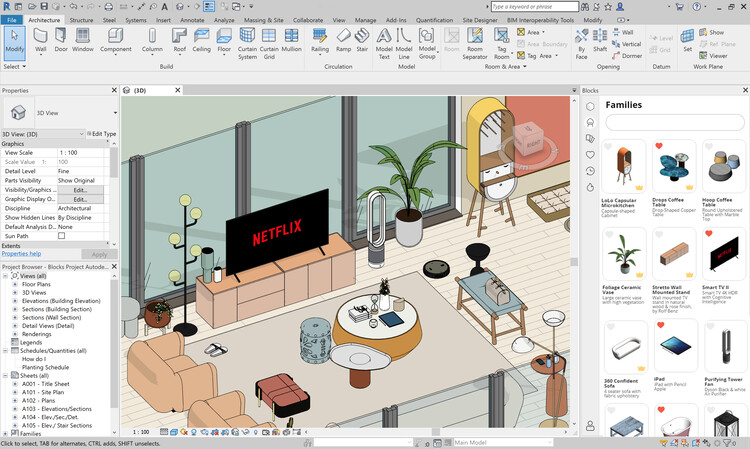
Revit and Building Information Modelling can be especially relevant for designers targeting large commercial practices, multidisciplinary consultancies and organised project environments.
Not every interior designer needs to become a BIM specialist.
A designer working mainly on boutique homes may rely more heavily on AutoCAD, SketchUp, visualisation, materials and execution knowledge. Someone working on large corporate or institutional interiors may gain greater value from Revit and coordinated digital workflows.
The important point is specialisation.
Interior Designer Salary often improves when a designer develops capabilities that match the kind of projects employers struggle to deliver without skilled people.
Your Portfolio Can Influence Interior Designer Salary More Than You Think
A portfolio is not simply a collection of attractive renders.
For an employer, it is evidence.
Can you plan a difficult space? Can you solve circulation problems? Do your concepts survive technical development? Can you detail furniture? Do you understand materials? Have your projects actually been built?
A designer who can show concept sketches, layouts, working drawings, materials, development stages and completed photographs tells a much stronger professional story.
As experience grows, this can influence Interior Designer Salary negotiations far more than simply adding another software name to a CV.
Residential vs Commercial Interior Designer Salary
There is no reliable evidence that allows us to say residential interior designers always earn more than commercial designers, or vice versa.
Both fields can lead to strong careers.
Residential designers often develop expertise in customised furniture, kitchens, wardrobes, materials, lighting and close client interaction. Designers working in luxury residential projects may eventually handle extremely high-value homes.
Commercial interior designers may work in offices, retail stores, restaurants, hotels and other larger environments where project coordination and technical integration can become more complex.
Interior Designer Salary in either field depends on expertise, scale, company and responsibility rather than the project category alone.
Interior Designer Salary vs Freelance Income
A salaried interior designer and a freelance interior designer should not be compared purely by looking at monthly revenue.
An Interior Designer Salary is generally a defined amount paid by an employer. Freelancers and studio owners may charge fixed design fees, percentages, per-square-foot rates or project-based fees.
But revenue is not take-home income.
Independent professionals may have to account for staff salaries, travel, visualisation costs, software, office expenses, consultants, marketing and periods without projects.
Freelancing can eventually create much greater earning possibilities, but it also involves business risk.
For many designers, employment provides the project exposure and practical experience needed before independent practice becomes realistic.
CTC and In-Hand Interior Designer Salary Are Not the Same
When evaluating a job offer, check whether the quoted figure is CTC, gross salary or take-home salary.
A ₹6 lakh annual CTC does not automatically mean ₹50,000 will reach your account every month.
Provident fund contributions, insurance, taxes, performance-linked incentives and other components can affect monthly take-home pay.
When comparing Interior Designer Salary offers, compare like with like.
A slightly larger CTC with a substantial variable component may not necessarily provide more guaranteed monthly income than a smaller but mostly fixed package.
Can Changing Jobs Increase Interior Designer Salary?
Changing companies can sometimes result in a salary increase, especially once a designer has developed skills that another employer urgently needs.
But moving only for a higher Interior Designer Salary can become limiting if the new position adds no meaningful experience.
Early in a career, the strongest move is often the one that improves both compensation and capability.
A role that introduces you to larger projects, better documentation, new materials, consultant coordination, senior mentors or direct client responsibility may strengthen your next salary negotiation as well.
Interior Designer Salary Growth Is Really About Becoming Harder to Replace
The designers who build the strongest careers are usually not those who simply collect years of experience.
They become useful at more stages of a project.
They can understand the brief, create the concept, develop the space, communicate with the client, produce technical information, coordinate specialists and solve problems when construction does not go according to plan.
Every additional responsibility increases professional value.
And over time, professional value has a much stronger relationship with Interior Designer Salary than the number printed beside “years of experience” on a résumé.
Is Interior Design a Good Career in India in 2026–27?
For someone who genuinely enjoys design as well as problem-solving, interior design can offer multiple career directions.
The Interior Designer Salary at entry level may be modest compared with what some students expect. Current data from Indeed and Glassdoor places junior averages around ₹18,000–₹20,000 per month, although actual salaries can move below or above that depending on the job.
But interior design does not end with the junior designer title.
Professionals can progress towards Senior Interior Designer, Project Designer, Design Manager, Design Lead, Studio Head, project-management positions, specialised design roles or independent practice.
That is why judging an entire career from the first Interior Designer Salary can give a misleading picture.
Interior Designer Salary in India 2026–27: The Final Picture
So, how much can an interior designer really earn in India?
Current September 2026 Indeed data places the overall average Interior Designer Salary at ₹23,572 per month. Junior-level Indeed data reports ₹18,314 per month, while Glassdoor shows junior base pay around ₹15,000–₹25,000 per month with approximately ₹20,000 average base pay.
For senior professionals, Glassdoor currently reports approximately ₹30,000–₹56,000 per month in base pay, with average base pay around ₹41,000. Its estimated senior total-pay trajectory sits around ₹5–8 lakh annually, although individual reported salaries and current job advertisements show that experienced specialists can earn substantially more.
Current vacancies illustrate that wider market clearly. Senior roles can be found around ₹35,000–₹60,000 per month, while certain specialised positions advertise ₹12–15 lakh annually. These are individual opportunities rather than market-wide guarantees.
The biggest takeaway is that Interior Designer Salary cannot be understood through one number.
Experience matters. City matters. Company size matters. Project type matters. Software knowledge matters. Technical understanding matters. Client handling matters. And above all, the level of responsibility you can take matters.
A fresher should focus on building the foundation.
A junior designer should focus on becoming independent.
A mid-level designer should learn to own projects.
A senior designer should be able to lead people, projects and decisions.
Do that consistently, and Interior Designer Salary becomes less about chasing a number and more about increasing the professional value behind that number.
That is where the real earning potential of an interior design career begins.